
Reviewed · JAIPUR FOOD & STREET EATS
3 Days Private Khajuraho Historical Tour with Breakfast
Khajuraho is a rare mix of art and nerve. In just over 3 days, you’ll move from modern Delhi to 10th-century temple India to see UNESCO-listed carvings—some of the most famous sensual sculpture work in the world—still carved into stone centuries later.
I especially like that the pacing is built for real viewing time, not rushed selfies. You get a professional guide and ticketed visits at major sites, including Javari, Chausath Yogini, Kandariya Mahadev, Lakshmana, Varaha, plus Jain and Shiva-related temples on Day 3.
One thing to plan for: this is a concentrated temple route with fairly short stop times (often 20–30 minutes each), so you’ll want good walking shoes and the mental switch to focus on details fast. Also, the tour depends on good weather.
In This Review
- Key things to know before you go
- Flying from Delhi to Khajuraho without losing a day
- Price and Logistics: what you pay for (and what you don’t)
- Your Day 2: the classic Hindu temple sweep in 5 stops
- Javari Temple: a UNESCO start on a raised stage
- Chausath Yogini Temple: 64 shrines and posture variety
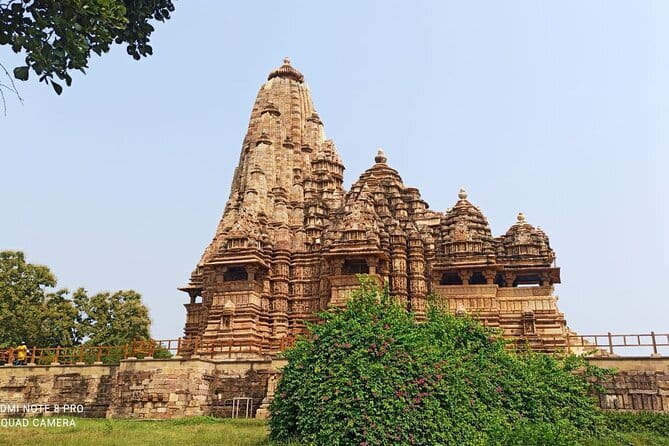
- Kandariya Mahadev Temple: the Chandela masterwork
- Lakshmana Temple: a Vaikuntha idol with three heads and four arms
- Varaha Temple: Saraswati and the stone’s musical energy
- The elephant (and lion) in the room: reading erotic stonework respectfully
- Day 3: Shiva near the Khodar River, plus Jain Parshwanath and Jagdamba
- Dulhadev Temple: Shiva as a bridegroom, plus the chariot shape
- Bhagawan Parshwanath Digambar Jain Mandir: motifs and instrument-playing goddesses
- Devi Jagdamba Temple: Parvati, pyramidal roof, and mythical beasts
- Hotels, guides, and local support that feels more than PR
- Practical tips so the 20–30 minutes per stop feels worth it
- Who this tour suits best
- Should you book this 3-day private Khajuraho historical tour?
- FAQ
- How long is the Khajuraho tour?
- What time does the tour start?
- Are flights between Delhi and Khajuraho included?
- Is hotel accommodation included?
- Is breakfast included?
- Are temple admission tickets included?
- Is food other than breakfast included?
- Is this tour private?
- What is the cancellation policy for a full refund?
- Does the tour run in any weather?
Key things to know before you go
- Flights + hotel included: you’re not cobbling together Delhi–Khajuraho travel on your own.
- Admission tickets are built in for the temple stops, so you spend less time dealing with lines.
- A private setup: it’s only your group, with a dedicated guide and private car.
- Hindu and Jain temples together: you’ll see different traditions and symbol sets in one tight run.
- Sculpture-first sightseeing: expect to spend more time looking at stonework than big-tour bus stops.
- Weather matters: if conditions are poor, you’ll be offered a different date or a full refund.
Still hungry? More kachori, ghewar and chaat stops
- Jaipur Bazaar & Food Walking Tour
★ 5.0 · 281 reviews - Heritage Walk & Street Food Tasting in Jaipur
★ 5.0 · 158 reviews - Cultural Walk and Food Tasting In Jaipur
★ 5.0 · 118 reviews - Guided Morning Bicycle Tour with Food Tasting in Jaipur
★ 5.0 · 117 reviews
Flying from Delhi to Khajuraho without losing a day
This tour keeps your time where it counts: on temples. You depart Delhi by flight at 3:30 pm, land in Khajuraho around 4:50 pm, check in, and move on with the trip already running. On Day 3, you’re dropped to the airport at 3:00 pm, then fly back to Delhi at 5:10 pm for a 6:25 pm arrival.
That timing is useful if you don’t want a long overland slog between the two places. It also makes the whole experience feel like a single “temple block” instead of a travel day stitched onto sightseeing.
You’ll also have pickup offered and a private car in Khajuraho for the temple circuit, which matters because the sites aren’t all next door to each other.
Price and Logistics: what you pay for (and what you don’t)
At $435 per person, the value comes from what’s bundled. You’re getting:
- 2 nights of hotel stay in Khajuraho
- Breakfast included
- Private car for the sightseeing days
- A professional guide
- Economy flights from Delhi to Khajuraho and back
- Admission tickets included for each listed temple stop
What’s not included is simple: food and beverages beyond breakfast. In practice, that means you’ll need to budget for lunch, snacks, and dinner separately during both Day 2 and Day 3.
For many people, the biggest “value win” is the flights plus hotel plus guided, ticketed temple visits all packaged together. You’re paying for coordination and local expertise—not just entry to one site.
Your Day 2: the classic Hindu temple sweep in 5 stops
Day 2 is built around the best-known Hindu cluster. You start after breakfast, then move temple to temple with time to actually look at carvings rather than just pass by.
Javari Temple: a UNESCO start on a raised stage
You’ll visit Javari Temple, a UNESCO World Heritage Site. It sits on a high pedestal, which instantly changes how you view it: you notice the exterior stonework and then shift your focus toward the interior artistry. This is a good first stop because you get your “reading glasses” on right away—by the time you reach the more complex layouts later, you’ll know what to search for in the carvings.
Admittedly, the visit window is about 30 minutes, so come in with a quick plan: look for the doorways, column details, and the way figures are framed.
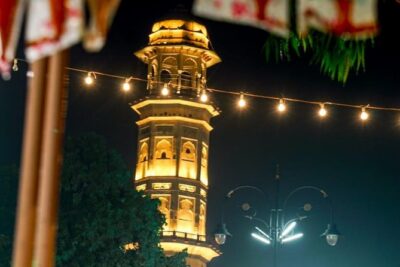
Deeper into old-town Jaipur
Chausath Yogini Temple: 64 shrines and posture variety
Next is Chausath Yogini Temple, dedicated to yoginis—women depicted as practitioners or teachers in the spiritual tradition. The big feature is structural: there are 64 different shrines, with the central shrine being the largest. The temple is mainly built from granite, which affects how the stone holds detail.
Each yogini statue has a different posture, and that difference is the whole point. Spend your minutes here carefully: don’t just glance—pick one shrine and compare the posture work. It’s one of the better places in the route to slow down mentally even if the clock keeps moving.
Kandariya Mahadev Temple: the Chandela masterwork
Then comes Kandariya Mahadev Temple, designed and built by Chandela King Vidyadhara in the early 11th century. The guide context matters here: this region endured invasion and destruction, and the temple stands as part of the post-invasion cultural recovery story.
Look for the entrance area, especially the Makara Torana—it’s singled out for good reason. Inside, you’ll see intricate hallways leading toward the main hall where the main deity is represented by a linga. There’s also a painting described as a four-footed incarnation of Lord Shiva called Chatuspada.
This stop often feels like the turning point of the whole day because Kandariya’s scale and stone detailing demand attention.
Lakshmana Temple: a Vaikuntha idol with three heads and four arms
Next is Lakshmana Temple, built by Chandela ruler King Yashovarman in the 10th century. The key visual is the main idol of Lord Vaikuntha, described as having three heads and four arms. You’ll also see it alongside avatars connected to Narasimha (lion form) and Varaha (boar form).
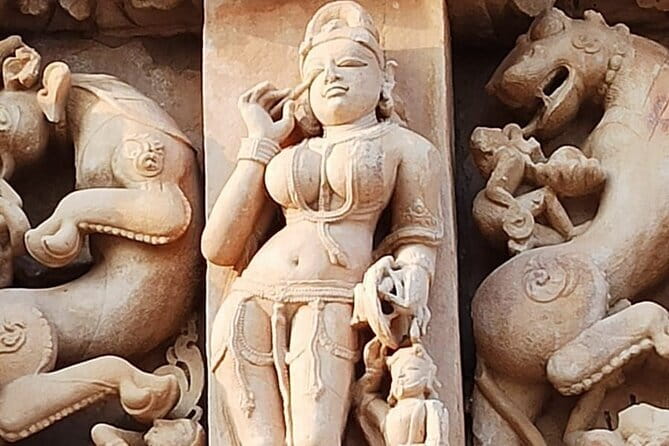
One detail worth seeking out: the statues of beautiful women shown with their partners in love. These are the kinds of stone narratives that make Khajuraho more than architecture—it’s storytelling.
Varaha Temple: Saraswati and the stone’s musical energy
The final Hindu stop on Day 2 is Varaha Temple, an incarnation of Vishnu with a boar head on a human body and four arms. You’ll notice many carvings, and the standout here is the depiction of Goddess Saraswati playing her veena.
This is a good closer because it reminds you that the art isn’t only sensual or symbolic—it also points to music, learning, and the roles deities play in daily life themes.
The elephant (and lion) in the room: reading erotic stonework respectfully
Khajuraho is often sold as the Kamasutra temple circuit, and yes—erotic sculptures are part of what people came to see. But here’s the smarter way to handle it: treat the carvings as part of a larger icon system.
On this tour, your guide’s job is to help connect what you’re seeing to the temple’s overall religious and artistic purpose. You’ll still spot the sensual themes, but you’ll also notice that these carvings sit alongside deities, myths, and ritual geometry. That balance makes the experience feel less like shock tourism and more like understanding a specific medieval worldview.
Day 3: Shiva near the Khodar River, plus Jain Parshwanath and Jagdamba
Day 3 is shorter, calmer, and more diverse. You’ll visit three temple stops, with about 30 minutes each. This is a nice shift from Day 2’s temple density.
Dulhadev Temple: Shiva as a bridegroom, plus the chariot shape
You’ll start with Dulhadev Temple, where Lord Shiva is depicted as a bridegroom—hence the name wordplay around dulha/dhuladeo. This temple is described as the last temple built in the whole group, located on the banks of the Khodar River.
The architecture is unusual: the temple is shaped like a saptadhara (a chariot) driven by seven horses. Even if you’re not an architecture nerd, this is the kind of distinctive form that makes the stonework feel almost theatrical. It helps you reset your brain after the highly detailed carving work earlier.
Bhagawan Parshwanath Digambar Jain Mandir: motifs and instrument-playing goddesses
Then you move into Jain territory with Bhagawan Parshwanath Digambar Jain Mandir. The Parshwanath temple was built by Chandela ruler Dhanga in the early 10th century. Here, the carvings and motifs lean into life and symbolism: you’ll see patterns described as including male and female figures, Gemini, trees and flowers, plus references to Ganga and Yamuna.
Inside, the idols of female goddesses are playing musical instruments such as gandarva, manjeera, shankha, mridanga, and vadya. Whether you’re into Jain tradition or not, this is a strongly visual stop because the theme is so specific—music embodied as stone.
Devi Jagdamba Temple: Parvati, pyramidal roof, and mythical beasts
Finally, Devi Jagdamba Temple houses a statue of Goddess Parvati. The temple features an intricately designed pyramidal roof and imaginative figures—beasts and mythical shardulas, including examples described as a lion body with a parrot head, plus other creature combinations like boar or elephant.
This stop is a great way to end because it ties back to the “stone stories” theme. After two days of Hindu sites, it gives you one last burst of symbol play and craftsmanship.
Hotels, guides, and local support that feels more than PR
You’re traveling with 5 Senses Walks (organized by Five Senses Tours). The company is described as recognized by India’s Ministry of Tourism and a member of IATO. That matters mainly because it signals a formal structure behind the scenes.
More important for your experience: the model is described as supporting local livelihoods by employing local guides and backing local businesses. In Khajuraho, that shows up in how the day runs—people who know the temples also tend to know how to explain them fast and clearly.
Your guide name might be Anurag, which has come up in prior experiences. Other cultural ambassadors mentioned include Vivek and Ram Sewak. While guide personalities vary, the pattern is consistent: your day benefits from someone who can point out the details you’d otherwise miss.
Practical tips so the 20–30 minutes per stop feels worth it
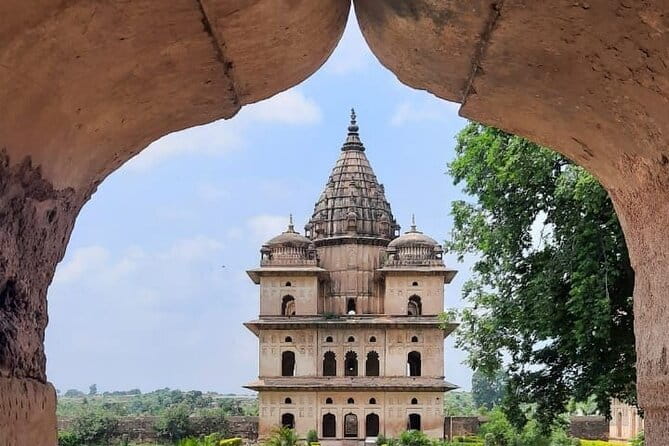
This tour is tightly scheduled, so don’t rely on “winging it.” Here’s how to make every stop pay off:
- Wear comfortable shoes and plan for uneven stone surfaces around temples.
- Choose one theme per stop before you enter: carvings on doors, posture differences at Chausath Yogini, entrance torana at Kandariya.
- If you’re interested in the sensual carvings, don’t treat them as the only feature. Look for how they sit among deities, myths, and scenes of daily life.
- Keep your camera ready, but don’t rush the viewing. A quick 10-second scan inside each temple beats a frantic photo later.
- Budget for meals beyond breakfast, since food and drinks are not included.
Also, because the tour requires good weather, check forecasts and be prepared for a date change if conditions are poor.
Who this tour suits best
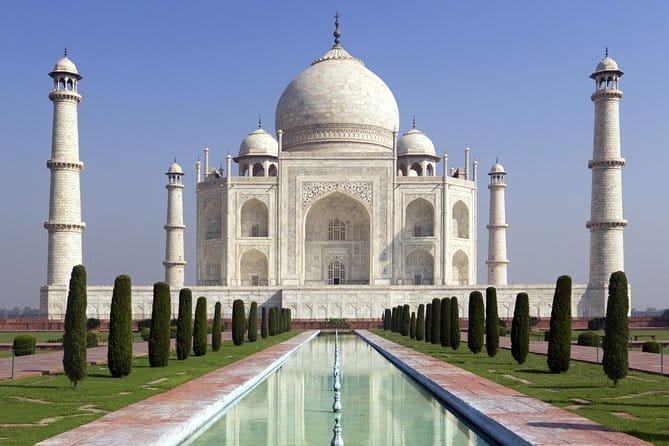
This is a strong fit if you want:
- A private temple itinerary without planning flights and hotel yourself
- A guide-led, architecture-and-sculpture focus
- Both Hindu and Jain sites in one trip
It’s also a good option if you’re short on time and don’t want to lose a full day getting from Delhi to Central India by road. If you prefer ultra-slow museum-style pacing with long stays at each place, you might find the stop times a little tight—but you can still get a lot out of it by choosing what to focus on.
Should you book this 3-day private Khajuraho historical tour?
If you want Khajuraho’s 10th–11th century temple world with minimal hassle, I’d book it. The big reason is value: flights, hotel, private transport, a professional guide, breakfast, and temple admissions are bundled into one price, and that makes the trip simpler than cobbling it together.
I’d think twice only if you hate tight schedules or you want very long, unstructured time at a single site. In that case, you may feel rushed. But for most people chasing the main temples and the stone storytelling that makes Khajuraho famous, this route hits a strong balance of coverage and focus.
FAQ
How long is the Khajuraho tour?
The tour is about 3 days, with flights and hotel stays across 2 nights in Khajuraho.
What time does the tour start?
The start time is listed as 3:30 pm.
Are flights between Delhi and Khajuraho included?
Yes. Economy flights from Delhi to Khajuraho and return are included.
Is hotel accommodation included?
Yes. You get 2 nights of hotel stay in Khajuraho.
Is breakfast included?
Yes. Breakfast is included as part of the tour.
Are temple admission tickets included?
Yes. Admission tickets are included for each listed temple stop.
Is food other than breakfast included?
No. Food and beverages are not included (beyond breakfast).
Is this tour private?
Yes. It’s described as a private tour/activity, meaning only your group participates.
What is the cancellation policy for a full refund?
You can cancel up to 3 days in advance for a full refund, and cancellations made less than 3 full days before the experience start time are not refundable.
Does the tour run in any weather?
The experience requires good weather. If it’s canceled due to poor weather, you’ll be offered a different date or a full refund.
Old Jaipur, Toured Properly
- Heritage Walk & Street Food Tasting in Jaipur★ 5.0 · 158 reviews
- Private Full-Day Sightseeing Tour of Jaipur’s Heritage by Car★ 5.0 · 110 reviews
- Jaipur Heritage Walk with Rickshaw Ride★ 5.0 · 105 reviews
- Jaipur Heritage Evening Walk – The Twilight Magic of Pink City★ 5.0 · 93 reviews
- Nahargarh Water Walk – Guided 2-Hour Heritage Tour in Jaipur★ 5.0 · 89 reviews
- Jaipur Heritage Walking Tour – Local life, Havelis and Temples★ 5.0 · 72 reviews
More Jaipur Tours to Compare
- Jaipur: Private Full Day Sightseeing Tour By Car with Guide★ 4.9 · 1,839 reviews
- 3-Hour Morning Bike Tour of Jaipur★ 5.0 · 1,253 reviews
- Jaipur: Private Sightseeing Day Tour with Guide by Car★ 4.8 · 773 reviews
- Jaipur: Full-Day City Tour with Car, Guide & Skip-the-Line★ 4.8 · 512 reviews
- Full-Day Jaipur Private Sightseeing Tour by Car with Guide★ 5.0 · 472 reviews
- Pink City Cooking Class★ 5.0 · 452 reviews
Eat Jaipur: More Street Food
- Jaipur Bazaar & Food Walking Tour★ 5.0 · 281 reviews
- Heritage Walk & Street Food Tasting in Jaipur★ 5.0 · 158 reviews
- Cultural Walk and Food Tasting In Jaipur★ 5.0 · 118 reviews
- Guided Morning Bicycle Tour with Food Tasting in Jaipur★ 5.0 · 117 reviews
- Jaipur Market Tour & Vegetarian Rajasthani Home Cooking Class★ 5.0 · 113 reviews
- Food Tour and Eat like Locals★ 5.0 · 111 reviews
Newly Added Jaipur Reviews

More from Jaipur Food & Street Eats.
 ★ 5.0Jaipur Bazaar & Food Walking TourFrom $37281 reviews
 ★ 5.0Heritage Walk & Street Food Tasting in JaipurFrom $21158 reviews
 ★ 5.0Cultural Walk and Food Tasting In JaipurFrom $22118 reviews
 ★ 5.0Guided Morning Bicycle Tour with Food Tasting in JaipurFrom $33117 reviews
 ★ 5.0Jaipur Market Tour & Vegetarian Rajasthani Home Cooking ClassFrom $60113 reviews
 ★ 5.0Food Tour and Eat like LocalsFrom $20111 reviews
 ★ 5.0Food Walking Tour in JaipurFrom $3971 reviews
 ★ 5.0Jaipur@Twilight Guided Heritage City walk tour with Food TastingFrom $2967 reviews
This tour also appears in