
Reviewed · JAIPUR SIGHTSEEING TOURS
Jaipur Sightseeing Day Trip With Tour Guide
Jaipur is a feast for the eyes, and this tour is built to move fast. What makes it interesting is the private setup and the chance to see major monuments with a driver-guide named Raj Kumar Gupta, a longtime Rajasthan tourism professional. You get a clear route, quick stops, and the kind of pacing that helps you connect what you see to what’s going on behind the scenes.
I especially like two things: first, the stop at Amber Fort, which is known for blending Hindu & Muslim elements and for elephant rides. Second, the itinerary includes both Jantar Mantar (astronomical instruments) and Hawa Mahal (pink-and-red sandstone with ties to the Zenana/ women’s quarters), so you’re not just looking at pretty facades—you’re seeing how rulers thought about power, space, and daily life.
One drawback to keep in mind: admission tickets are not included for several of the big stops (Amber Fort, City Palace, Jantar Mantar, and Hawa Mahal), so you should budget for entry fees on top of the tour price. Also, the info I was given lists a Day 2 slot but doesn’t specify the actual Day 2 stop, so you’ll want to confirm that before you rely on this plan.
In This Review
- Key highlights you’ll actually feel on the ground
- Meet Raj Kumar Gupta: the human thread through Jaipur
- Price and what $108.02 covers (and what it doesn’t)
- The pacing: a 2-day plan that still feels like a sprint
- Day 1: Amber Palace and the big “wow” moments
- Stop 1: Amber Palace (Amber Fort) — 1 hour 30 minutes
- Stop 2: Jal Mahal — 5 minutes (free)
- Stop 3: City Palace of Jaipur — 1 hour 30 minutes
- Jantar Mantar and Hawa Mahal: science meets palace design
- Stop 4: Jantar Mantar — 30 minutes (ticket not included)
- Stop 5: Hawa Mahal (Palace of Wind) — 30 minutes (ticket not included)
- Stop 6: Panna Meena ka Kund — 10 minutes (free)
- Jal Mahal and Panna Meena ka Kund: why short stops can still count
- Day 2: what’s missing from the details you have
- Pickup, mobile tickets, and how the logistics affect your comfort
- Who this tour fits best (and who should reconsider)
- Should you book the Jaipur Sightseeing Day Trip with Tour Guide?
- FAQ
- How long is the Jaipur sightseeing experience?
- Is pickup offered for this tour?
- Is this a private tour?
- Do I get a mobile ticket?
- Are admission tickets included for the main monuments?
- What start time is listed for the tour?
- Can I cancel and still get a full refund?
- What happens if weather is poor?
- Is the tour recommended for travelers with heart problems?
Key highlights you’ll actually feel on the ground
- Private group ride that keeps your sightseeing flow calm and focused
- Raj Kumar Gupta’s guidance shaped by 20+ years driving tourists in North India and Rajasthan
- Amber Fort: famous for Hindu–Muslim design influence and elephant rides
- Jantar Mantar + Hawa Mahal: science-meets-palace architecture in two compact stops
- Ticket mix: some attractions are free (like Jal Mahal and Panna Meena ka Kund), while others need separate admission
- Weather matters since the experience requires good weather
The big Jaipur hits, gathered in one run
- Jaipur: Private Full Day Sightseeing Tour By Car with Guide
★ 4.9 · 1,839 reviews - Jaipur: Private Sightseeing Day Tour with Guide by Car
★ 4.8 · 773 reviews - Jaipur: Full-Day City Tour with Car, Guide & Skip-the-Line
★ 4.8 · 512 reviews - Full-Day Jaipur Private Sightseeing Tour by Car with Guide
★ 5.0 · 472 reviews
Meet Raj Kumar Gupta: the human thread through Jaipur
This tour lives or dies by the guide, and here you get someone with real tenure in the region. Raj Kumar Gupta has more than 20 years in tourism, including work as a driver for visitors from places like the UK, Germany, the USA, Canada, Russia, and the Philippines. That matters because you’re not just getting directions—you’re getting a translator between cultures and context.
What stands out from the way people describe the experience is the personality angle. The guide’s behavior is praised as very good, and visitors highlight his humility. In plain terms: you’ll get explanations that feel friendly, not like a scripted lecture you forget five minutes later.
If you care about learning, this route also supports that. Even when a stop is short (30 minutes at Hawa Mahal, for example), you’ll have a guide to point out what to look for, so your time doesn’t dissolve into random photo-taking.
Price and what $108.02 covers (and what it doesn’t)
The price is listed at $108.02 per person, and it includes pickup and a mobile ticket. For a two-day duration (listed as approx.), you’re essentially paying for transportation + guided structure across multiple major landmarks.
Here’s the part that changes the value math: several entries are not included. Amber Fort, City Palace, Jantar Mantar, and Hawa Mahal all say admission ticket not included. Two other sights are marked free: Jal Mahal and Panna Meena ka Kund.
So the question isn’t only whether the tour is “cheap” or “expensive.” It’s whether the tour saves you stress and time. With this kind of lineup, a guide can help you avoid pointless wandering and keep you moving at the right pace. If you’re the type who likes to understand what you’re seeing while you walk, the price usually makes sense. If you just want a quick look and don’t care about context, you may spend extra money for guidance you won’t use much.
The pacing: a 2-day plan that still feels like a sprint
Even though this is labeled as a day trip, the duration is listed as about 2 days. That tells me this is designed to cover major Jaipur highlights without turning into a slow museum crawl. Expect a route that prioritizes “see the essentials” over “linger for hours.”
Your start time is listed as 12:00 am. That’s midnight on paper, which could be a data-entry oddity. I’d treat this as a reminder to confirm your actual pickup time when you book—especially if you don’t want to stand around at night waiting for the car.
You’ll also want to pay attention to the “good weather” note. This doesn’t mean you need sunshine and perfection, but it does mean the operator expects conditions that make outdoor stops comfortable and safe.
Day 1: Amber Palace and the big “wow” moments
Day 1 is where the route hits the highest-visibility monuments. The order also makes sense if you like momentum: you start with Amber Fort, then slide to nearby sights, then move toward central Jaipur highlights.
A shortlist worth scanning before you book:



Stop 1: Amber Palace (Amber Fort) — 1 hour 30 minutes
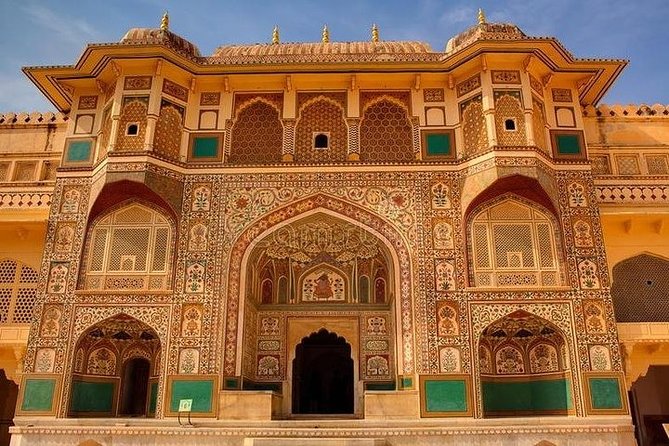
Amber Fort is described as a structure that collaborates Hindu & Muslim elements and offers elephant rides. That single line tells you why this stop is a centerpiece: it’s not only a view-point fortress; it’s a place where design styles meet, and visitors can even interact with the tradition of elephant rides if they choose to.
You’re given 1 hour 30 minutes, so you’ll have time to take in the setting without rushing. If you’re sensitive to walking uphill or crowded entry areas, plan your energy for this as your main physical moment of the day.
Admission ticket not included, so this is also the first likely “extra cost” on your day. If you don’t want surprises, factor that in before you arrive.
Stop 2: Jal Mahal — 5 minutes (free)
Then the pace lightens at Jal Mahal. It’s described as a grand palace made of red sandstone, sitting in the middle of Man Sagar Lake, with most of it submerged.
The stop time is only 5 minutes, which signals that this is mainly for quick viewing and a scenic break rather than a long indoor visit. Since admission is marked free, it’s a low-commitment stop with high photographic payoff.
Practical tip: treat it like a photo-and-breathe stop. Don’t plan on “deep exploration” here because the schedule doesn’t support it.
Stop 3: City Palace of Jaipur — 1 hour 30 minutes
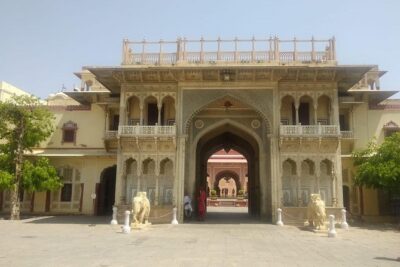
City Palace is given 1 hour 30 minutes, and the description gives you a key timeline: Maharaja Sawai Jai Singh Ji II established it alongside the city of Jaipur, then moved his court from Amber to Jaipur in 1727.
That date is useful because it turns the palace from a generic “royal building” into a signpost for a shift—Amber to Jaipur, power concentrating in one location, and the city becoming the stage for court life.
Admission ticket not included here, so expect another separate purchase. But with the time slot, you should be able to see enough to feel oriented: the palace is the hinge between the fort mindset and the city mindset.
Jantar Mantar and Hawa Mahal: science meets palace design
These two stops together are a good pairing because they show different sides of how rulers thought—one more about measuring the sky, the other about shaping space for daily life.
Stop 4: Jantar Mantar — 30 minutes (ticket not included)
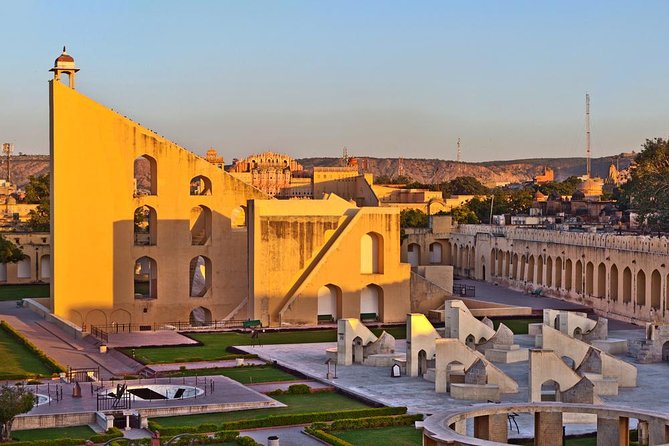
Jantar Mantar is described as a collection of nineteen architectural astronomical instruments, built by the Maharaja Rajput king for knowing the time and whether. Even with the truncated ending, that’s the core idea: this is not random architecture. It’s built to track something practical about the world above you.
With 30 minutes, your goal should be clarity, not exhaustiveness. You’ll want to focus on what the instruments are for and how they connect to observing time and conditions. If you like “this is how people measured the sky before gadgets” style explanations, this stop tends to land well.
Admission ticket is not included, so budget for it.
Stop 5: Hawa Mahal (Palace of Wind) — 30 minutes (ticket not included)
Hawa Mahal gets 30 minutes, and the description highlights its materials and placement: made with red and pink sandstone, sitting on the edge of the City Palace, and extending to the Zenana (women’s chambers).
Even if you only catch the exterior and key viewpoints, the Zenana mention gives the building a functional story. It’s not only a pretty façade; it’s connected to a way of living and moving through the palace world.
Again, admission is not included. But since the time slot is short, it’s easier to decide whether the ticket is worth it for you—if you’re already paying for other entries today, you’ll likely treat Hawa Mahal as part of the same “royal architecture bundle.”
Stop 6: Panna Meena ka Kund — 10 minutes (free)
Then you end with a smaller, older-feeling stop: Panna Meena ka Kund, described as the oldest stepwell in Amber town. The time is 10 minutes, and it’s marked free.
A stepwell doesn’t need hours to make an impression. The value here is contrast: you’ve spent the day with palaces and palace-adjacent symbols, and now you get a practical structure tied to water. Even if you only walk around for a bit, it adds texture to the picture of how people handled daily needs.
Jal Mahal and Panna Meena ka Kund: why short stops can still count
Not every stop needs to be long to be meaningful. Jal Mahal and Panna Meena ka Kund are both free, and both are described with clear “what to look at” hooks: Jal Mahal’s submerged red sandstone on the lake, and Panna Meena ka Kund’s age and stepwell identity.
So your strategy for these short stops is simple:
- Give them your full attention for a few minutes, not half-attention while thinking about the next ticket.
- Use the guide to get the quick context, so you don’t just see a photo backdrop—you see a purpose.
If you’re the kind of traveler who gets restless waiting in lines at big monuments, these short stops can feel like a nice reset.
Day 2: what’s missing from the details you have
Your itinerary info shows Day 2, but the Day 2 stop details aren’t included in what I was given. That doesn’t mean the tour is empty; it means the plan here is incomplete.
Before you book (or before you commit to any pre-planned schedule), I’d message the operator and ask:
- What exact monuments or locations are scheduled for Day 2?
- How long is each stop?
- Are any additional admission tickets not included on Day 2?
This is one of those situations where confirming saves frustration. You don’t want to arrive on Day 2 expecting a specific site and then discover your day was something else.
Pickup, mobile tickets, and how the logistics affect your comfort
This is a private tour/activity, meaning only your group will participate. That’s a comfort factor if you hate the “tour herding” vibe, especially in a city where roads and crowds can change quickly.
Pickup is offered, and the experience is listed as near public transportation. If you’re arranging your own hotel transfer or you’re meeting the group after arriving in town, that “near transit” note usually helps with flexibility.
You also get a mobile ticket, which cuts down on paperwork. In cities where lines can form, being able to show your ticket digitally is practical—especially when you’re juggling multiple sights.
One caution: the experience is not recommended for travelers with a heart problem. That likely relates to the physical demands of outdoor sightseeing and walking between stops. If that applies to you, it’s worth discussing with the operator before committing.
Who this tour fits best (and who should reconsider)
This tour suits you if:
- You want a structured route that hits major Jaipur landmarks without planning every step yourself
- You value explanation from a guide with long regional experience, like Raj Kumar Gupta
- You’re okay paying separate admission fees for several key monuments
It may not fit you as well if:
- You hate paying extra entry charges and prefer fully included ticket bundles
- You’re sensitive to walking or outdoor time and need a gentler pace
- You want a “slow and deep” experience at each site rather than a packed sightseeing day
Also, if you’re photo-focused, this can work—but treat it like a shot list with context. The best results come when you balance photos with 1-2 guided takeaways per stop.
Should you book the Jaipur Sightseeing Day Trip with Tour Guide?
I’d book it if you want an organized way to see Jaipur’s best-known royal-and-science landmarks with a guide who’s been doing this for decades and comes across as humble and helpful. The strongest selling points are the private format, the Amber Fort + City Palace + Jantar Mantar + Hawa Mahal sequence, and the mix of paid and free stops that keeps the day varied.
Skip or reconsider if the separate ticket costs are a deal-breaker for you, or if you need very clear Day 2 details in writing. In that case, ask the operator what Day 2 includes before you spend money.
FAQ
How long is the Jaipur sightseeing experience?
It’s listed as approximately 2 days.
Is pickup offered for this tour?
Yes, pickup is offered.
Is this a private tour?
Yes. It’s described as a private tour/activity, with only your group participating.
Do I get a mobile ticket?
Yes, mobile ticket delivery is listed.
Are admission tickets included for the main monuments?
Admission tickets are marked as not included for Amber Palace, City Palace of Jaipur, Jantar Mantar, and Hawa Mahal. Jal Mahal and Panna Meena ka Kund are marked as free.
What start time is listed for the tour?
The start time is listed as 12:00 am.
Can I cancel and still get a full refund?
You can cancel up to 3 days in advance for a full refund. If you cancel less than 3 days before the start time, the amount paid is not refunded.
What happens if weather is poor?
The experience requires good weather. If it’s canceled due to poor weather, you’ll be offered a different date or a full refund.
Is the tour recommended for travelers with heart problems?
No. It’s not recommended for travelers with heart problems.
More 1-Day Tours in Jaipur
- Private Jaipur Full One Day Tour In Pink City With Guide★ 5.0 · 322 reviews
- From Jaipur: Ranthambore National Park Day Trip with Safari★ 4.6 · 244 reviews
- From Jaipur: Private Taj Mahal & Agra Day Trip with 5* Lunch★ 4.9 · 161 reviews
- Ranthambore Tiger Safari Day trip from Jaipur – All Inclusive★ 4.5 · 87 reviews
- Jaipur- 1 Day Private Tour With Guide★ 5.0 · 81 reviews
- Jaipur Guided Day Trip By Car★ 5.0 · 55 reviews
More Jaipur Tours to Compare
- Jaipur: Private Full Day Sightseeing Tour By Car with Guide★ 4.9 · 1,839 reviews
- 3-Hour Morning Bike Tour of Jaipur★ 5.0 · 1,253 reviews
- Jaipur: Private Sightseeing Day Tour with Guide by Car★ 4.8 · 773 reviews
- Jaipur: Full-Day City Tour with Car, Guide & Skip-the-Line★ 4.8 · 512 reviews
- Full-Day Jaipur Private Sightseeing Tour by Car with Guide★ 5.0 · 472 reviews
- Pink City Cooking Class★ 5.0 · 452 reviews
All of Jaipur in a Day
- Jaipur: Private Full Day Sightseeing Tour By Car with Guide★ 4.9 · 1,839 reviews
- Jaipur: Private Sightseeing Day Tour with Guide by Car★ 4.8 · 773 reviews
- Jaipur: Full-Day City Tour with Car, Guide & Skip-the-Line★ 4.8 · 512 reviews
- Full-Day Jaipur Private Sightseeing Tour by Car with Guide★ 5.0 · 472 reviews
- Private Full Day Jaipur Sightseeing Tour By Tuk Tuk★ 5.0 · 382 reviews
- Jaipur: Private Full-Day Guided City Tour★ 4.9 · 308 reviews
Newly Added Jaipur Reviews



More from Jaipur Sightseeing Tours.
 ★ 4.9Private Full Day Sightseeing Tour By Car with GuideFrom $41,839 reviews
 ★ 4.8Private Sightseeing Day Tour with Guide by CarFrom $5773 reviews
 ★ 4.8Full-Day City Tour with Car, Guide & Skip-the-LineFrom $9512 reviews
 ★ 5.0Full-Day Jaipur Private Sightseeing Tour by Car with GuideFrom $11472 reviews
 ★ 5.0Private Full Day Jaipur Sightseeing Tour By Tuk TukFrom $5382 reviews
 ★ 4.9Private Full-Day Guided City TourFrom $22308 reviews
★ 5.0Full-day Jaipur Private Sightseeing Tour by Car with GuideFrom $75240 reviews
 ★ 5.0Private Full Day Jaipur Tour with GuideFrom $5214 reviews
This tour also appears in