
Reviewed · GOLDEN TRIANGLE TOURS FROM JAIPUR
Golden Triangle Tours
Six days, three icons, one smooth route. I like the private feel—your group drives a classic Golden Triangle loop without getting tangled in trains or schedules. I also appreciate that pickup is offered and you get a mobile ticket, which makes arrival days calmer.
Here’s the one thing to watch: monument entries are mixed. Several major stops list admission tickets as not included (think Taj Mahal and forts), so your final budget will depend on what you pay on arrival.
In This Review
- Key things that make this tour work
- Private Golden Triangle: what you’re really buying for $343
- Pickup, mobile ticket, and a team that keeps you on track
- Delhi: Qutub Minar, Humayun’s Tomb, Red Fort, plus Lotus Temple and Jama Masjid
- Qutub Minar and a guided start
- India Gate and classic Old Delhi passes
- Lotus Temple and Jama Masjid: two very different calm stops
- Agra: Taj Mahal first, then Agra Fort and Mehtab Bagh
- Taj Mahal: plan for a full attention window
- Agra Fort: fort architecture and river-side imagination
- Mehtab Bagh: a view stop that’s about the frame
- Fatehpur Sikri and Chand Baori: your best “extra” day
- Fatehpur Sikri: long enough to feel the layout
- Chand Baori: short, graphic, and unforgettable
- Jaipur’s key stops: Amber Fort, Jal Mahal, City Palace, Jantar Mantar
- Amber Fort: give it your best energy
- Jal Mahal: a quick look that still counts
- City Palace: 1.5 hours of royal architecture
- Jantar Mantar: the science stop
- What’s included vs what you pay for at each monument
- Transport and day flow: how to handle the “full circuit” feeling
- Who should book Golden Triangle Tours, and who should rethink it
- Final call: should you book this Golden Triangle tour?
- FAQ
- How long is the Golden Triangle tour?
- Where does the tour take place?
- Is pickup included?
- Do I need to pay admission tickets at each attraction?
- Is this tour private?
- Is there a minimum number of travelers?
- What happens if the weather is bad or I need to cancel?
Key things that make this tour work
- Private group travel with only your group in the vehicle
- Pickup offered and a mobile ticket for an easier start
- Mughal highlights in Delhi and Agra plus Jaipur fort-and-palace classics
- Free admission at select sites, while others are ticketed separately
- Private pacing choices since your guide can adapt to your interests, time, and budget
- Time-efficient stop lengths, keeping you moving without feeling lost
Delhi, Agra and Jaipur strung together
- From Delhi: Private 3-Day Golden Triangle Tour with Hotels
★ 4.9 · 339 reviews - From Delhi: Private 5-Day Golden Triangle Tour
★ 4.9 · 208 reviews - Golden Triangle Tour – Delhi-Agra-Jaipur
★ 5.0 · 73 reviews - 3-Days Golden Triangle’s Private Tour
★ 5.0 · 69 reviews
Private Golden Triangle: what you’re really buying for $343
At this price point, you’re not just paying for a route. You’re paying for less friction: someone to coordinate the flow, a vehicle waiting when you need it, and guides at key moments so you don’t waste time translating every plaque and legend on your own.
Golden Triangle tours can feel either too rigid or too vague. This one lands closer to practical and structured. You’ll hit the headline sights—Delhi’s Mughal-era power centers, Agra’s big-ticket monuments, then Jaipur’s forts, palaces, and astronomical spectacle. The tradeoff is that it’s a full circuit in roughly 6 days, so it’s best for people who like to keep moving and don’t mind some walking and stairs.
The private setup also matters for comfort. With a group just of your party, you avoid the slow churn of larger bus tours. It’s easier to manage photo stops, bathroom breaks, and timing around crowds. You’ll also get a clear plan for each day’s stops, which helps when you’re dealing with traffic, heat, and the sheer sensory load that comes with India’s capital cities.
One more plus: the tour is described as customizable. That means if you want to slow down for a mosque courtyard, spend longer on a fort ramp, or adjust priorities, you have room to do it. If you’re the type who prefers a menu with choices instead of a take-it-or-leave-it script, that’s a big value.
Pickup, mobile ticket, and a team that keeps you on track
This is a private tour/activity, with only your group participating. There’s a minimum of 2 people to book, which usually means the logistics are set up for a small party rather than random walk-ins.
Pickup is offered, and you’ll have a mobile ticket. In real-world terms, that means fewer surprises at the start: you’re not stuck hunting down an office or deciphering local instructions while you’re already tired from travel. You’re also told the experience is “near public transportation,” which generally helps if you need a quick reference point before your guide arrives.
The human side is important too. The tour provider, Raj India Tours, is tied to Raj (listed as Raj Kumar Gupta in the tour description). In past trip feedback shared with the tour, the big theme is quick communication and smooth coordination, especially via WhatsApp, along with punctual driving and safe navigation.
If you’re the kind of person who worries about missing a turn or getting delayed by traffic, this is exactly what you want. The best value here isn’t the brochure—it’s the day-to-day execution.
One caution: the tour is NOT recommended for travelers with heart problem. Even without making assumptions, you should treat that seriously. Several of these sites involve steep stairs, uneven stone, and standing/walking time in sun and crowds. If that’s relevant to you, ask your doctor and plan accordingly.
Delhi: Qutub Minar, Humayun’s Tomb, Red Fort, plus Lotus Temple and Jama Masjid
Delhi is split in your mind into two moods: monumental Mughal grandeur and calm spiritual geometry. This tour uses both.
Qutub Minar and a guided start
The day begins with a city-tour rhythm and includes Qutub Minar with an English-speaking guide. The time block is short—about 30 minutes—so you’ll want to arrive ready to look up, not just wander. Qutub Minar rewards attention: the details in the stonework and the way the complex sits around it are hard to appreciate if you treat it like a quick photo stop.
Admission for Qutub Minar is listed as not included, so expect to pay your monument entry separately.


India Gate and classic Old Delhi passes
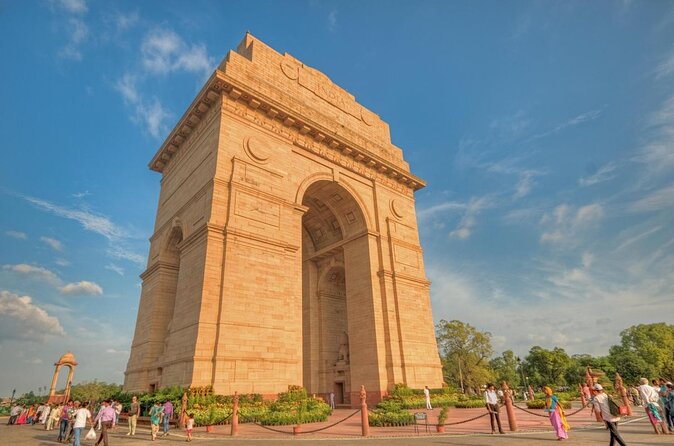
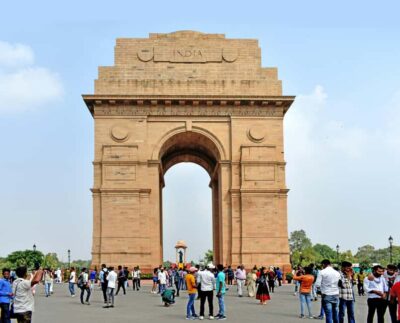
You’ll also pass India Gate along the Rajpath. Your time there is more about seeing the landmark than ticketing anything, since the schedule reads like a visual stop.
Then you move deeper into Old Delhi energy with Humayun’s Tomb (about 30 minutes) and Red Fort (about 45 minutes). Both are iconic Mughal statements, and the short timing means you should pick what you want most:
- walking the main lanes for the overall layout, or
- focusing on architecture details and framing views.
Both are marked with admission not included. Practically, that’s a good thing: it keeps your schedule flexible, but it means you should carry some money and plan for ticket lines.
Lotus Temple and Jama Masjid: two very different calm stops
Later, the tour drops you into two calmer spiritual spaces.
Lotus Temple is marked as admission ticket free and timed at about 30 minutes. It’s a welcome break from forts and tomb architecture because it feels like quiet geometry in motion—visually striking, and usually easier on your feet than climbing-heavy sites.
Then comes Jama Masjid, about 30 minutes, also marked as admission ticket free. This is one of Delhi’s major mosques, and even if you don’t religiously connect with the site, the scale and courtyard layout are the real story. Dress and comfort matter here. Bring something that lets you move easily and covers as needed.
Main Delhi consideration: Delhi is where your legs will feel it first. If you’re sensitive to crowds, start the trip with good hydration and an early mindset. Also, because several admissions are not included, you’ll need to handle some ticket payments during the day rather than assuming everything is prepaid.
Agra: Taj Mahal first, then Agra Fort and Mehtab Bagh
Agra is where the Golden Triangle goes from “great sights” to “wow, that’s real.” The schedule keeps your time targeted.
Taj Mahal: plan for a full attention window
The day includes Taj Mahal for about 2 hours, and the admission ticket is listed as not included. Two hours is a sweet spot: enough time to take photos, but also enough time to understand the layout. Don’t treat this as a sprint. Instead, slow down for the main sightlines and then circle for the surrounding perspective.
Because the monument is so famous, crowds can be intense. You’ll get the most out of your time if you choose a couple of viewing angles instead of chasing everything.
Agra Fort: fort architecture and river-side imagination
Next is Agra Fort for about 1 hour. Again, admission is not included. Forts in India are not just walls—they’re cities of decisions. Even with a limited time, you’ll feel how the power center was built to control views and movement.
Mehtab Bagh: a view stop that’s about the frame
Then there’s Mehtab Bagh for about 30 minutes. This is usually a short stop, but it can be a satisfying one if you like framing. It’s not about buying more time—it’s about seeing the monument with a different context.
Agra budget note: since tickets for Taj Mahal and Agra Fort are not included, your biggest cost here can come in one or two payments. If you like knowing your spending, keep a separate budget card or envelope for monument entries.
Fatehpur Sikri and Chand Baori: your best “extra” day
Day 4 gives you two very different kinds of wow—one is an emperor’s planned city, the other is a geometric stepwell.
Fatehpur Sikri: long enough to feel the layout
Fatehpur Sikri is scheduled for about 2 hours and is listed with admission ticket free. That’s a great setup because it lets you spend time without worrying about paying an extra monument fee on top.
The experience here is about wandering the complex with purpose. It’s easy to spend two hours just looking at doorways, courtyards, and the way the red sandstone shapes the entire place. If your feet start tiring, remember you don’t have to cover every corner—aim for the central spaces and the entrance details.
Chand Baori: short, graphic, and unforgettable
Then you go to Chand Baori (Step Well) for about 30 minutes with admission not included. This is one of those stops that doesn’t need a long narrative to be impressive. You look down, you see layers, and you understand why people stop here for photos.
It’s also a good midday reset. If you pace yourself at Fatehpur Sikri, Chand Baori feels more like a visual payoff than another endurance test.
Jaipur’s key stops: Amber Fort, Jal Mahal, City Palace, Jantar Mantar
Jaipur is where you trade the Mughal scale of Delhi and Agra for a Rajput blend of power, design, and science.
Amber Fort: give it your best energy
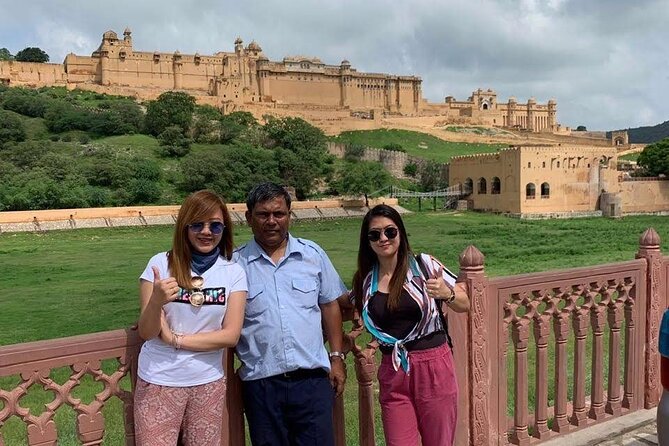
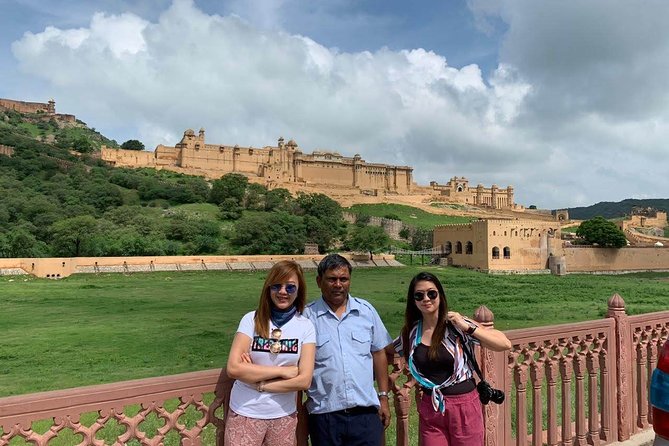
Amber Fort takes about 1 hour 30 minutes and is listed as admission not included. This is the heavy hitter of the day. It’s also physically demanding in parts because of stairs and ramped pathways. If you want nice photos, don’t just rush to the main viewpoints—move slowly and choose angles that show the fort’s layered layout.
Jal Mahal: a quick look that still counts
Jal Mahal is timed at about 10 minutes and is listed as admission ticket free. It’s short, but that’s normal for this stop. It’s best enjoyed as a pause—an eye-catching palace-in-the-water image that breaks up the fort-palace sequence.
City Palace: 1.5 hours of royal architecture
City Palace of Jaipur is scheduled for about 1 hour 30 minutes with admission not included. This is where you can feel the identity of Jaipur as a lived-in royal center rather than only a scenic monument. Your best use of time here is to watch how the palace layout connects into the city fabric.
Jantar Mantar: the science stop
Finally, Jantar Mantar is about 30 minutes, admission not included. It’s a collection of astronomical instruments built by Sawai Jai Singh II. Even if you’re not a science person, it’s the kind of place that makes your brain click—because it’s physical. You can see how measurement became architecture.
Jaipur timing consideration: This day stacks big sites with smaller breaks. If you’re prone to fatigue, plan to use the Jal Mahal stop as a rest moment. Also, keep in mind that ticket-paying sites aren’t prepaid, so bring a payment plan.
What’s included vs what you pay for at each monument
The price is $343 for an approximately 6-day private tour with pickup offered and a mobile ticket. That price sounds simple, but your real cost picture depends on entry fees.
From the schedule:
- Tickets are listed as free at Lotus Temple, Jama Masjid, Fatehpur Sikri, and Jal Mahal.
- Tickets are listed as not included at Qutub Minar, Humayun’s Tomb, Red Fort, Taj Mahal, Agra Fort, Chand Baori, Amber Fort, City Palace, and Jantar Mantar.
So think of it like this: you’re paying for guided logistics and time. You’re paying separate monument fees at many headline sites.
If you want value math, a quick rule helps: budget for monument entries as an extra line item, then compare the remainder of the price to what it would cost you to arrange transport and guides yourself. With a private group, hiring a driver and coordinating guide timing can become expensive fast. This tour aims to package that coordination into the rate.
Transport and day flow: how to handle the “full circuit” feeling
The route moves you in a way that keeps momentum: Delhi first, then Agra, then Fatehpur Sikri/stepwell, then Jaipur with forts and palace stops. The last day ends with a drop-off at Delhi or Jaipur airport.
That means you should be realistic about travel time and energy. Six days in India’s triangle isn’t a slow stroll—it’s a sequence of highlights where you’ll spend more time sightseeing than relaxing.
A smart approach for this type of tour:
- start each day with your biggest-walk-site first,
- keep water and sun protection handy,
- and don’t plan too many extra add-ons on your own outside the scheduled stops.
Also, the schedule indicates confirmation will be received at time of booking, and the meeting point is listed as near public transportation. So do what you’d do with any private tour: confirm exact pickup timing and where you should wait. The start time shows 12:00 am, which often reflects a system placeholder. Use your confirmation message as the real source for daily timing.
Who should book Golden Triangle Tours, and who should rethink it
This tour is a strong fit if:
- you want a classic Golden Triangle route with coordination handled,
- you prefer private-group pacing instead of a big bus,
- you like guided context at major sites rather than reading every sign alone,
- and you’re okay paying some monument fees directly at attractions.
It may be less ideal if:
- you need a low-walking plan due to health or mobility constraints,
- you want every admission fee included in one simple total (this tour has multiple sites labeled not included),
- or you’re traveling when weather is unstable.
One more factor: the experience description says it requires good weather. If conditions are poor, it may be canceled and you’d be offered another date or a full refund. So if you’re planning tightly around flights, build in some flexibility when possible.
Final call: should you book this Golden Triangle tour?
If your goal is to see the big names—Delhi’s Mughal monuments, Taj Mahal, Fatehpur Sikri, and Jaipur’s forts and science site—while keeping transportation and timing handled, this tour looks like solid value for a private setup at $343.
I’d book it if you’re comfortable budgeting extra for monument admissions that are marked not included, and if you’re physically able for stairs and active sightseeing. I’d skip or ask serious questions first if heart-related health issues apply, since the tour explicitly says it’s not recommended.
In short: for first-time Golden Triangle visitors who want structure without stress, this is the kind of plan that makes India feel manageable.
FAQ
How long is the Golden Triangle tour?
The tour is listed as 6 days (approx.).
Where does the tour take place?
It runs through Delhi and Agra and ends with Jaipur, with a drop-off at Delhi or Jaipur airport on the final day.
Is pickup included?
Pickup is offered, and the tour confirms meeting details at booking time.
Do I need to pay admission tickets at each attraction?
Not all sites are included. Some stops are listed as admission ticket free, while many are not included. You should expect to pay entry fees for ticketed monuments when you arrive.
Is this tour private?
Yes. It’s described as a private tour/activity, meaning only your group participates.
Is there a minimum number of travelers?
Yes. The tour requires a minimum of 2 people (minimum 2 pax) to book.
What happens if the weather is bad or I need to cancel?
The experience requires good weather. If it’s canceled due to poor weather, you’re offered a different date or a full refund. You can cancel up to 3 days in advance for a full refund.
More Jaipur Tours to Compare
- Jaipur: Private Full Day Sightseeing Tour By Car with Guide★ 4.9 · 1,839 reviews
- 3-Hour Morning Bike Tour of Jaipur★ 5.0 · 1,253 reviews
- Jaipur: Private Sightseeing Day Tour with Guide by Car★ 4.8 · 773 reviews
- Jaipur: Full-Day City Tour with Car, Guide & Skip-the-Line★ 4.8 · 512 reviews
- Full-Day Jaipur Private Sightseeing Tour by Car with Guide★ 5.0 · 472 reviews
- Pink City Cooking Class★ 5.0 · 452 reviews
The Golden Triangle, End to End
- Golden Triangle & Ranthambore: 4-Day Private Tour from Delhi★ 5.0 · 355 reviews
- From Delhi: Private 3-Day Golden Triangle Tour with Hotels★ 4.9 · 339 reviews
- From Delhi: Private 5-Day Golden Triangle Tour★ 4.9 · 208 reviews
- Golden Triangle Tour – Delhi-Agra-Jaipur★ 5.0 · 73 reviews
- 3-Days Golden Triangle’s Private Tour★ 5.0 · 69 reviews
- Private 6-Day Golden Triangle Tour: Delhi, Agra, Jaipur by Car★ 5.0 · 60 reviews
Newly Added Jaipur Reviews




More from Golden Triangle Tours from Jaipur.
 ★ 5.0Golden Triangle & Ranthambore: 4-Day Private Tour from DelhiFrom $215355 reviews
 ★ 4.9From Delhi: Private 3-Day Golden Triangle Tour with HotelsFrom $93339 reviews
 ★ 4.9From Delhi: Private 5-Day Golden Triangle TourFrom $191208 reviews
Golden Triangle Tour – Delhi-Agra-JaipurFrom $32273 reviews
★ 4.9From Delhi: Private 5-Day Golden Triangle TourFrom $191208 reviews
Golden Triangle Tour – Delhi-Agra-JaipurFrom $32273 reviews
 ★ 5.03-Days Golden Triangle’s Private TourFrom $34269 reviews
 ★ 5.0Private 6-Day Golden Triangle Tour: Delhi, Agra, Jaipur by CarFrom $21560 reviews
 ★ 4.6From Delhi: Private 4-Day Golden Triangle Tour with PickupFrom $12338 reviews
 ★ 5.0Golden Triangle TourFrom $34036 reviews
This tour also appears in